
DTO · EN

DTO · EN
Where can we obtain the raw materials our company needs? How can we avoid supply disruptions? Which sourcing markets are still attractive? Is local or global sourcing the right choice? Unfortunately, most companies were not prepared for the current crisis and are looking for ways to eliminate weaknesses in their supply chains. There is no doubt that sourcing strategy is crucial to business success.
With a total of 888,000 employees and revenue of €191 billion last year, the electrical industry is one of Germany’s most important industrial sectors, alongside machinery and automotive.
The electronics industry already faced major challenges last year. Changes in key markets such as automotive, energy and healthcare directly affect demand for electronic components. Falling vehicle registrations last year, down 1.4% compared with 2018, Brexit, trade disputes between the USA and China, and now the emergency caused by the COVID-19 pandemic are all weighing directly on Germany’s second-largest industrial sector.
Recently published figures from the German Electrical and Electronic Manufacturers’ Association (ZVEI) show that the German electrical industry received 20.8% fewer new orders in April 2020 than in the same month a year earlier. Revenue also fell, reaching €12.5 billion in April 2020, 17.5% below the previous year. Total revenue for the first four months of the year points to a somewhat milder decline of 6.3% year on year.
In a recent study, DTO found that many German electrical companies had announced plans to restructure their supply chains. Those responsible stressed how important digital risk management will become in providing a transparent overview of the entire supply chain.
The industry is being reshaped, and factors such as delivery performance, reliability, quality and inventory management are overtaking the previously dominant goal of low procurement costs. Several electrical equipment manufacturers complain of disrupted cross-border supply chains and report delivery problems lasting weeks. Individual assemblies that had previously played only a minor role in the overall supply chain became unavailable during the shutdown, suddenly causing serious disruption for the companies affected.
The study’s findings also reinforce the trend towards local sourcing. Manufacturers want to avoid risks such as supply failures by identifying alternative suppliers and switching to multiple sourcing. Germany, France, Eastern Europe, the Baltic states and Scandinavia are emerging as particularly attractive sourcing regions. However, the benefits of global sourcing should not be dismissed too quickly. Sustainable, balanced risk management helps companies navigate the current crisis and provides stability and planning certainty. DTO will be happy to support your strategic crisis management and develop solutions tailored to your business and its supply and logistics chains, helping you emerge stronger from the restart phase and secure long-term success.
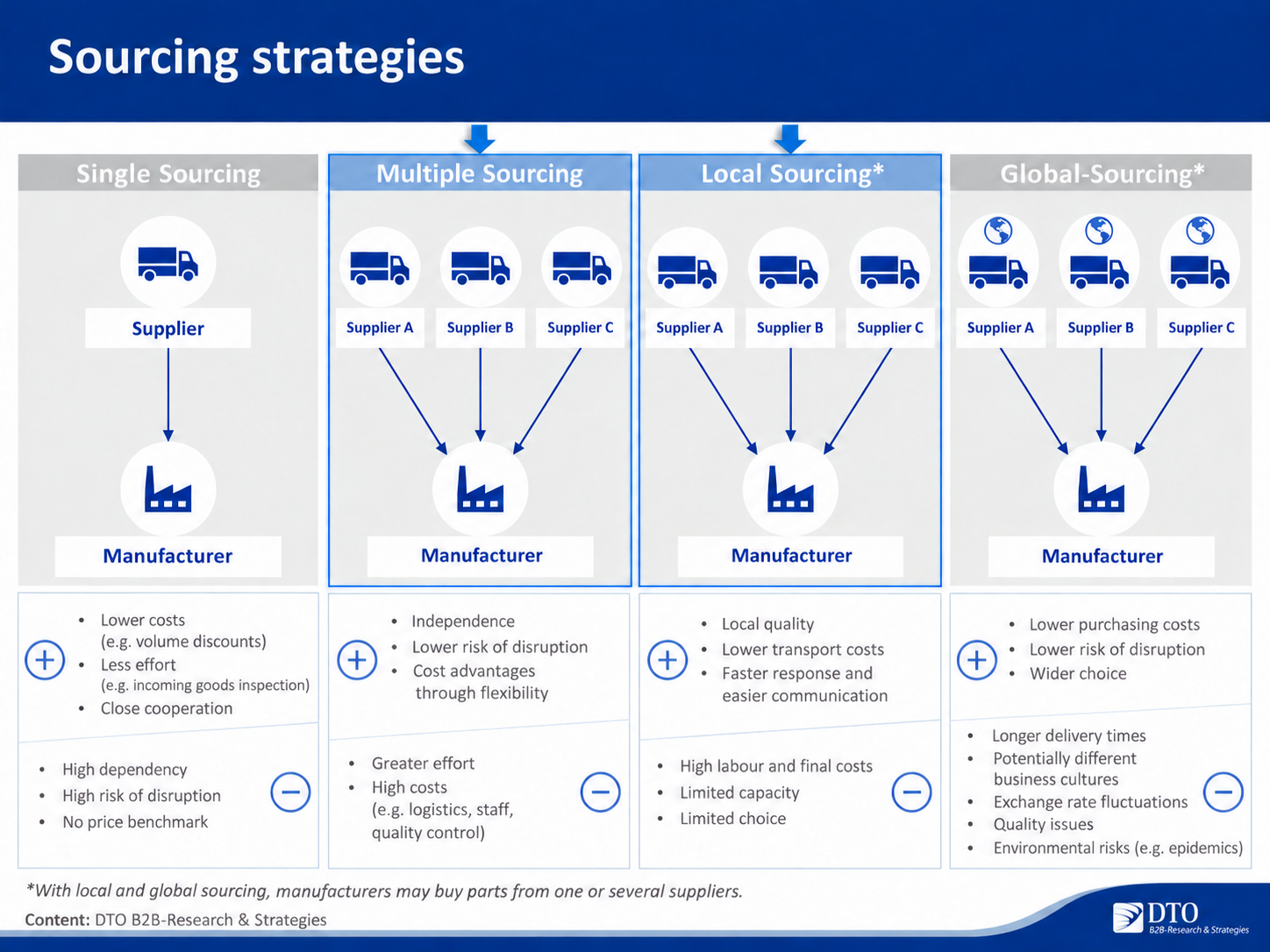 Sourcing strategies. Single sourcing: one supplier → manufacturer. Advantages: lower costs, for example volume discounts; less effort, for example incoming goods inspection; close cooperation. Disadvantages: high dependency; high risk of failure; no price benchmark. Multiple sourcing: suppliers A, B and C → manufacturer. Advantages: independence; lower risk of failure; price advantages through flexibility. Disadvantages: high effort; high costs, for example logistics, staff and quality control. Local sourcing: local suppliers A, B and C → manufacturer. Advantages: local quality; lower transport costs; faster response and easier communication. Disadvantages: high labour and final costs; limited capacity; limited choice. Global sourcing: international suppliers A, B and C → manufacturer. Advantages: lower purchasing costs; lower risk of failure; wider choice. Disadvantages: longer delivery times; potentially different business cultures; exchange-rate fluctuations; quality deterioration; environmental risks, for example epidemics. *Local and global sourcing may both use one or several suppliers. Content: DTO B2B-Research & Strategies. Source: ZVEI Economic Barometer, June 2020.