Market potential
Determine market volume and potential for products, machines, services and new applications.


DTO · EN
Professional cleaning is evolving from a labour-intensive service into an interplay of chemicals, machines, robotics, sensors, data and facility services. DTO analyses which changes actually generate demand and where they create attractive market potential.
Determine market volume and potential for products, machines, services and new applications.
Assess application potential, economic viability and acceptance of automated cleaning solutions.
Compare manufacturers, service providers, specialists and new business models.
Understand decision-making processes among facility managers, building operators, service providers and end customers.
Market Intelligence & Decision Model
DTO MIND stands for integrated market intelligence: operational relief, strategic clarity and sound decisions – even under uncertainty. As DTO's own adaptive approach, MIND systematically brings together secondary data, expert interviews and company-specific expertise.
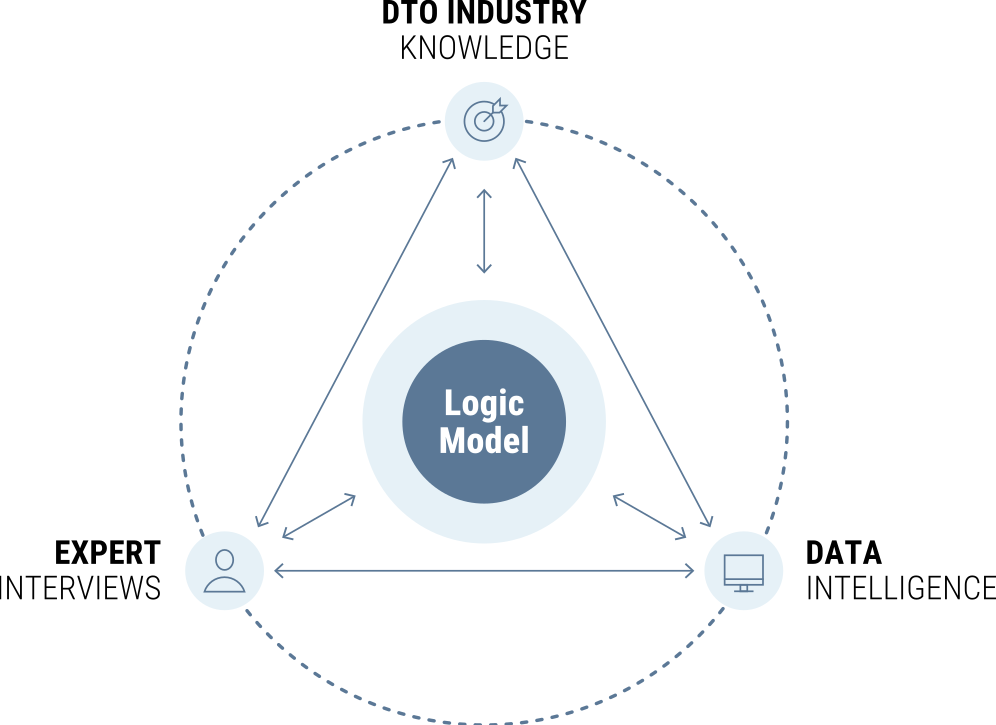
Systematically evaluate secondary sources such as databases, reports, information from industry associations, trade and customs statistics, and company information.
Expert interviews validate assumptions, close data gaps and explain the mechanisms behind figures and market movements.
Benchmarks, project experience and industry logic are combined with company-specific expertise to interpret evidence and derive sound decisions.
A building's floor area is not yet an addressable market. What matters is usage, floor type, cleaning frequency, accessibility, labour costs, operator structure and existing processes. DTO combines these factors into application-specific market models and complements them with interviews with service providers, facility managers, manufacturers and users.
Number of properties, floor areas, deployment rates, machine stock and revenue potential.
Suitable applications, payback, barriers to deployment and adoption scenarios.
Product strategies, sales models, service concepts and market positioning.
Purchasing criteria, tendering processes and decision-making processes.
DTO looks beyond total floor area, segmenting buildings by area type, accessibility, flooring, operating hours and staffing requirements. This provides a realistic picture of deployment and revenue potential.
Labour costs and staff availability increasingly influence automation decisions. Whether robotics is economically viable, however, depends heavily on building type, process integration, operating time and existing cleaning concepts.
Sensors and building data enable more demand-driven cleaning. This changes processes and potentially also the roles of building operators, service providers and technology suppliers.
Alongside cleaning performance, water and energy consumption, dosing, concentrates, packaging, circular models and verifiability are becoming more relevant.
Yes. Facility services in particular are often highly regional. DTO can examine provider structures, tender volumes, contract models, customer segments and consolidation at country or regional level.
Are you assessing a new product, robotics potential or a new target market? We combine market size, application and customer perspectives to create a sound basis for your decision.