Market potential
Translate products, applications, facilities and patient groups into realistic market potential.


DTO · EN
Medical technology combines complex procurement processes with regulatory requirements, clinical benefits and technological innovation. DTO analyses market potential, competition and decision-making structures, creating a robust foundation for growth and market entry.
Translate products, applications, facilities and patient groups into realistic market potential.
Assess procurement structures, regulatory frameworks and barriers to market entry.
Understand physicians, procurement, clinical engineering, management and other members of the buying centre.
Compare products, providers, installed bases and technological positioning.
Market Intelligence & Decision Model
DTO MIND stands for integrated market intelligence: operational relief, strategic clarity and sound decisions – even under uncertainty. As DTO's own adaptive approach, MIND systematically brings together secondary data, expert interviews and company-specific expertise.
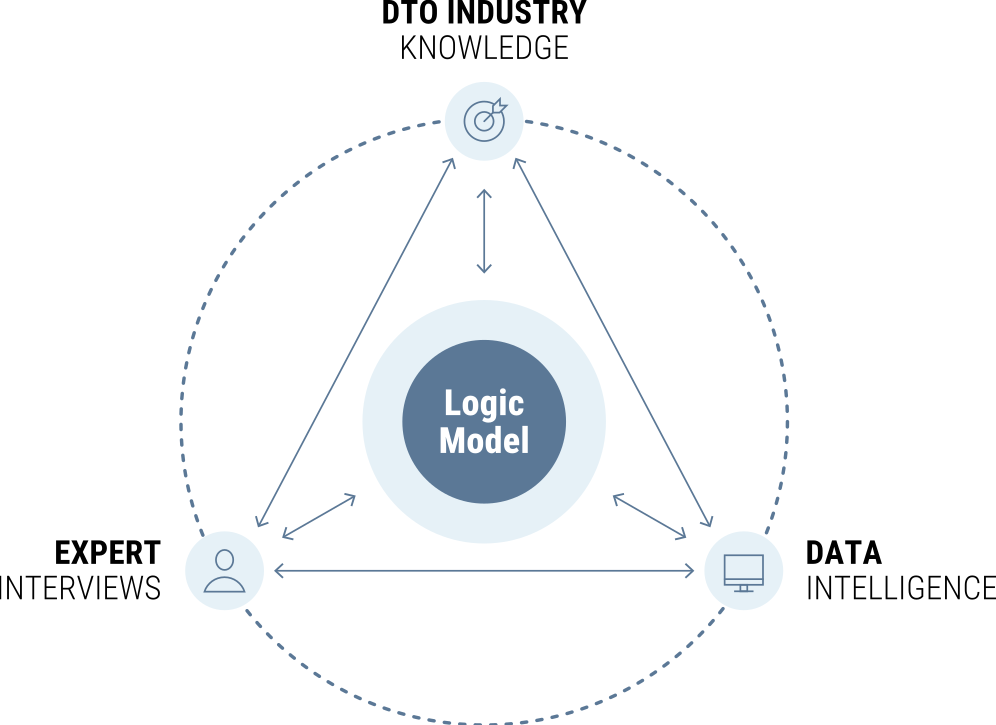
Systematically evaluate secondary sources such as databases, reports, information from industry associations, trade and customs statistics, and company information.
Expert interviews validate assumptions, close data gaps and explain the mechanisms behind figures and market movements.
Benchmarks, project experience and industry logic are combined with company-specific expertise to interpret evidence and derive sound decisions.
Product registers and public data provide important starting points, but rarely answer every commercial question. DTO combines secondary data with interviews with clinical users, procurement teams, technical decision-makers, dealers and other market participants. This helps validate market size estimates and understand the mechanisms behind procurement and use.

Digitalisation and artificial intelligence are transforming the medical industry. Several developments in the medical industry are actively addressing digital transformation. In particular, the “Smart Hospital” concept aims to optimise hospital processes th …
Read more
In the production of components and prototypes, industrial companies are increasingly relying on development processes with 3D printing technology. This is also accompanied by digitization in medical technology. Even if this development often only concerns …
Read more
Networking via IT processes within medical technology is increasing everywhere. Processes are optimized by modern software procedures. Private hospital groups are sometimes justifiably criticized for their fixation on efficiency, but these investments have …
Read moreFacilities, patient numbers, applications, installed equipment and revenue potential.
Roles, influence, decision criteria and procurement processes.
Product portfolios, installed base, market position and differentiation.
Target segments, sales channels, partners and priorities.
We examine clinical users, procurement, clinical engineering, IT, management and other relevant decision-makers separately, analysing their roles throughout the decision-making process.
Yes. We combine manufacturer information, public procurement data, hospital structures, product registers, service information and interviews with market participants.
The increasing use of central EUDAMED modules makes more structured information on actors, products and certificates available. This can be used to validate competitive and market structures.
Product class, certification status, notified bodies and potential portfolio changes are considered where they affect market availability, market entry or competition.
Alongside technology and regulatory approval, we examine clinical benefits, integration into existing workflows, data requirements, reimbursement and user acceptance in particular.
Yes. We examine market potential, regulatory frameworks, procurement, sales channels and relevant market participants separately for each country.
Would you like to quantify market potential, launch a new product or assess an international target market? Together, we identify the critical knowledge gaps.