Value creation & market access
Understand the market roles of manufacturers, component suppliers, distributors, integrators, planners and operators.


DTO · EN
DTO creates robust market transparency in technically complex, fragmented and international industrial markets. We combine data, primary research and genuine industry context so that you can assess market potential realistically, prioritise target markets and make market-entry decisions with greater confidence.
Understand the market roles of manufacturers, component suppliers, distributors, integrators, planners and operators.
Model applications, machinery stock, replacement cycles, investment logic and real demand.
Assess global providers, regional specialists, alternative technologies and new market entrants.
Make technical, commercial and operational decision-makers, as well as effective sales channels, visible.
Market Intelligence & Decision Model
In technically driven industrial markets, DTO MIND adapts data sources, interview partners and industry logic to the product, application, value-chain stage and region. This creates reliable transparency even in small or hard-to-access niches.
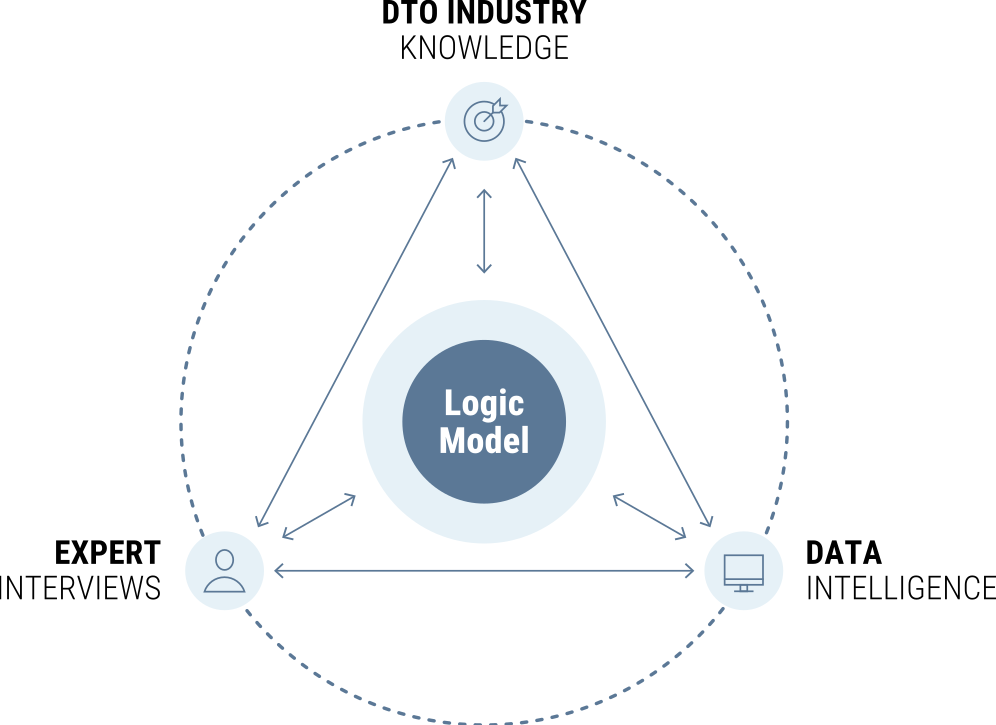
Company, production, trade, customs, product and installed-base data are systematically combined for technical niches.
Manufacturers, customers, users, distributors, integrators, planners and associations validate market models and explain technical and commercial mechanisms.
DTO benchmarks, project experience and sector-specific industry logic enable a reliable assessment of replacement cycles, market access, competition and actual demand.
Industry expertise is demonstrated through market definition, research and interpretation.

Applications, installed base, replacement cycles, distributor structures and international sales markets.

Supplier structures, technological change, the aftermarket and new mobility solutions.

Renewable energy, grids, storage, hydrogen and industrial energy supply.

Investment logic, regulation, grids, renewable energy and new technologies.

Automation, material flow, warehouse technology, fleets and system landscapes.

Medical technology, procurement routes, user requirements and regulatory conditions.

Equipment, services, professional users, digital solutions and technically complex niches.
market size, attainable potential, installed bases and development scenarios.
providers, roles, value-chain stages, applications and sales channels.
countries, segments, applications, partners and entry options.
opportunities, risks, uncertainties and concrete next steps.
At DTO, Industry Markets refers to complex, technically driven B2B markets in which public statistics alone do not provide a reliable picture. What matters is the combination of data, primary research and industry expertise, together with a rigorous interpretation of market mechanisms.
Product niches, regional providers, technical specifications and informal market mechanisms are often not represented precisely in standard statistics.
DTO does not analyse small industrial markets by maximising sample sizes, but by ensuring targeted structural coverage of relevant roles, customer groups, regions and applications. This creates a robust market picture despite the small underlying population.
Yes. DTO compares international markets not only by market size, but also by access, competition, regulation, channels, customer density, pricing logic and strategic fit.
DTO translates regulatory changes and standards into specific market implications. We analyse new product and documentation requirements, certification effort, market-entry barriers, procurement criteria, data access, service responsibilities and potential shifts within the value chain.
DTO combines company, product, production, trade and application data with expert knowledge. This provides a transparent basis for modelling machinery populations, replacement cycles and actual demand.
DTO classifies manufacturers, component suppliers, distributors, integrators, planners, operators and users according to their function, market power and importance for market access.
DTO uses conversations with market participants to close data gaps and explain technical and commercial mechanisms. The interviews also help validate market models and key assumptions.
Yes. DTO assesses alternative technologies, new market entrants, patents, product developments and potential substitution effects, incorporating them into the competitive landscape and market forecast.
DTO compares countries in terms of potential, customer density, competition, regulation, sales channels, partner landscapes, pricing logic and strategic fit. This reveals attractive target markets and realistic routes to entry.
DTO combines top-down and bottom-up approaches, technical market boundaries, structured coverage of market participants and transparent ranges to create a robust market picture.
Are you assessing a new country, application or business area? Together, we clarify which market mechanisms need to be understood and which decisions need to be secured.