Market potential
Assess market size, attainable potential and price-volume logic through data-driven market-potential analyses and prioritise attractive segments.


DTO · EN
When standard data is not enough, DTO uses B2B Market Intelligence to create a robust market picture for your market development. You receive realistic potential estimates, clear priorities and concrete courses of action for market entry, growth and competition.
Assess market size, attainable potential and price-volume logic through data-driven market-potential analyses and prioritise attractive segments.
Identify direct and indirect providers, regional specialists and substitutes, and use continuous competitor monitoring to support positioning and differentiation.
Understand customer needs, purchasing criteria, willingness to pay and buying centres.
Prioritise countries, applications, sales channels, distributors and partners for a tailored market-entry strategy.
Market Intelligence & Decision Model
For customised B2B market studies, DTO MIND combines fragmented secondary data with targeted insights from market participants and industry experience tested in practice. This creates a robust market picture tailored precisely to the decision at hand.
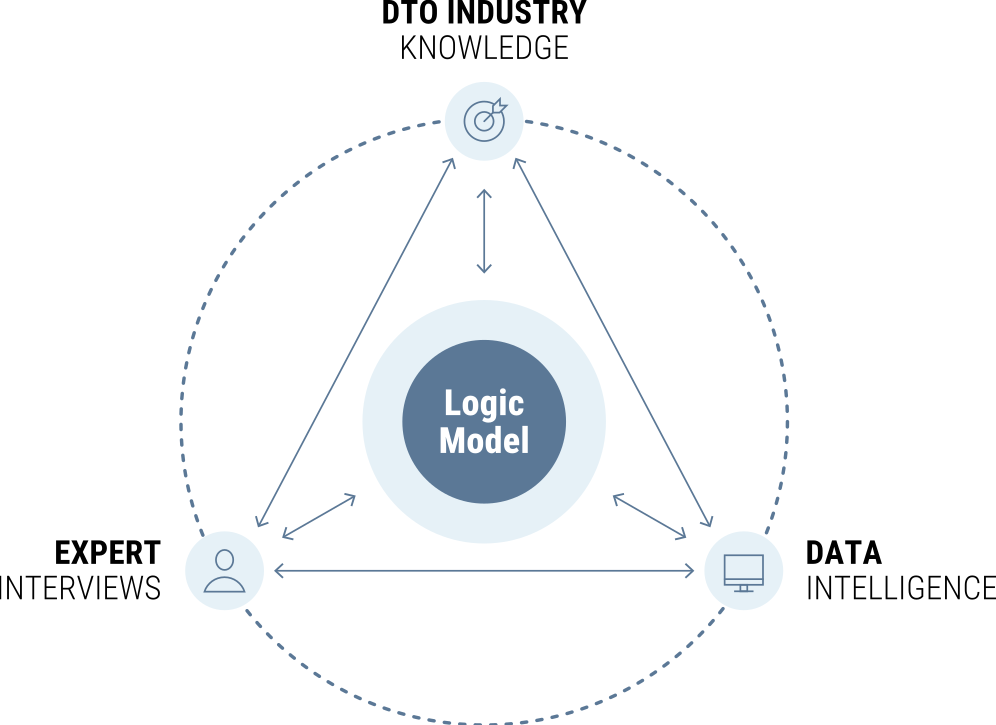
Databases, industry reports, associations, trade and customs statistics, and company information are consolidated around the specific market definition.
Interviews with customers, users, distributors and industry experts test market assumptions, close gaps and explain purchasing and competitive mechanisms.
DTO benchmarks, project experience and industry logic help assess and prioritise market sizes, segments and market-entry options realistically.
A small number of clear findings, presented without unnecessary complexity. What you receive:
Transparent calculations within customised market studies, including assumptions, ranges and development scenarios.
Transparency on providers, roles, product groups, channels and value-chain stages—also as a robust basis for M&A processes and commercial due diligence.
Precise market segmentation and buying-centre analysis reveal who decides, influences, blocks and implements within the purchasing process.
Priorities, risks, uncertainties and concrete next steps for the decision.
Key findings are validated across multiple independent sources and perspectives.
Facts, projections, expert statements and remaining uncertainties are clearly separated.
Technical specifications, installed base, distributor structures and purchasing processes are incorporated into the assessment.
The analysis does not begin with the available dataset, but with the management decision that needs to be made.
B2B Market Intelligence integrates market, competitor, customer and technology intelligence. DTO combines data analysis, traditional B2B market research, structured expert interviews and industry experience to turn fragmented information into a robust basis for decision-making.
DTO combines top-down and bottom-up models, including company data, installed bases, prices, volumes, trade data and expert estimates.
DTO identifies hard-to-find competitors through targeted industry analyses, verified data sources, product and trade research, specialist media and associations. Insights from customers, distributors and users are also incorporated so that regional specialists and niche players become visible.
Yes. DTO can include CRM, quotation, sales, service and product data to test external market assumptions and reveal additional potential.
Yes. DTO supports international market decisions through targeted country analyses, showing clearly which target markets offer realistic opportunities, risks and entry barriers.
Depending on the question, a customised B2B market study covers market size, growth, competition, customers, buying centres, technologies, sales channels, partners and strategic courses of action. Its scope and methodology are aligned with the specific management decision.
DTO combines available data and specialised secondary sources with interviews or surveys of market participants. This helps validate figures, close data gaps and improve understanding of the mechanisms behind the market.
Yes. DTO can continuously monitor relevant providers, products, partnerships, market developments and strategic changes through a structured monitoring approach, interpreting the findings to support decisions.
DTO documents calculation methods, data sources, assumptions, ranges and development scenarios transparently. This makes it clear which findings are based on facts, models or expert estimates.
B2B Market Intelligence supports the assessment of target markets, entry barriers, customer segments, competition, positioning, sales channels, distributors and partners. DTO uses these insights to identify realistic routes to market and prioritised next steps.
DTO consistently aligns market definition, methodology and analysis with the customer’s specific decision, rather than simply summarising existing standard data.
What market decision are you facing? Together, we define the market, target picture and knowledge gaps—and develop an appropriate research framework.