Market potential
Quantify technologies, applications, customer groups and addressable accounts.


DTO · EN
Cloud, AI, connectivity, cybersecurity and digital platforms are creating new markets, while technology and procurement decisions are becoming more complex. DTO analyses market potential, competition and customer requirements, revealing where growth is actually achievable.
Quantify technologies, applications, customer groups and addressable accounts.
Compare providers, platforms, ecosystems and alternative solutions.
Understand technology decisions, buying centres and purchasing criteria.
Develop target customers, partners, sales channels and positioning.

Market Intelligence & Decision Model
DTO MIND stands for integrated market intelligence: operational relief, strategic clarity and sound decisions – even under uncertainty. As DTO's own adaptive approach, MIND systematically brings together secondary data, expert interviews and company-specific expertise.
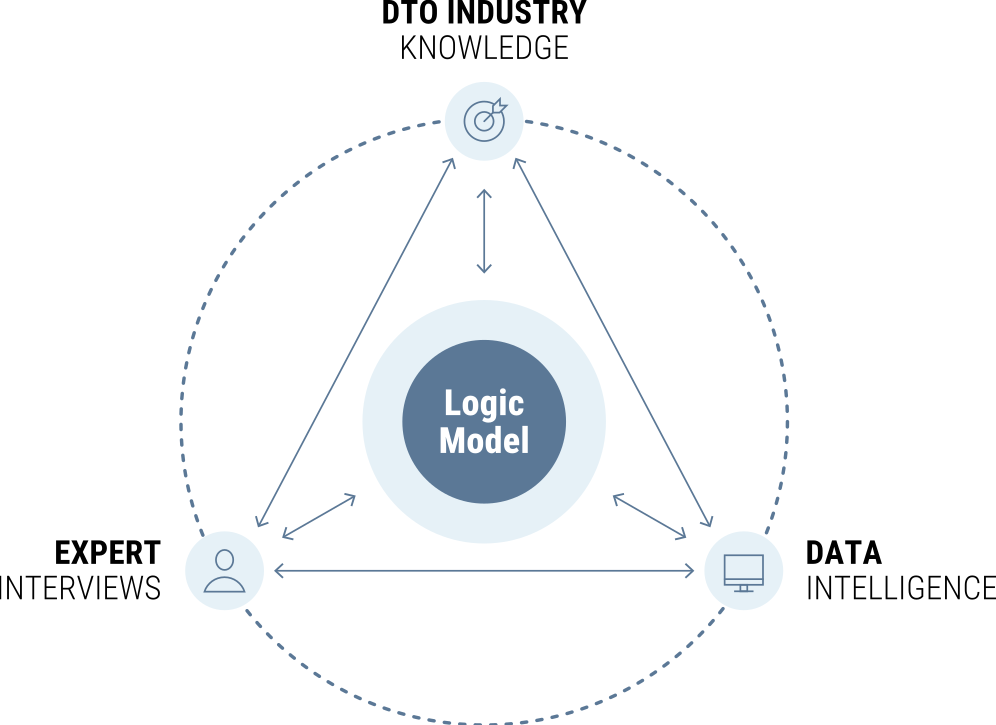
Systematically evaluate secondary sources such as databases, reports, information from industry associations, trade and customs statistics, and company information.
Expert interviews validate assumptions, close data gaps and explain the mechanisms behind figures and market movements.
Benchmarks, project experience and industry logic are combined with company-specific expertise to interpret evidence and derive sound decisions.
Technological relevance does not automatically imply a willingness to pay. DTO therefore investigates not only market trends but also specific use cases, existing solutions, investment budgets, decision-making processes and switching barriers on the customer side.
Accounts, users, installations, licences and revenue potential.
Providers, products, platforms, pricing and business models.
Use cases, pain points, purchasing criteria and buying centres.
Target segments, value proposition, pricing and sales.
Yes. Companies can be segmented by factors such as industry, size, IT landscape, use case, technology use or willingness to invest.
Depending on the product, we examine IT, business departments, procurement, finance, information security and executive management separately, for example.
Yes. Alongside direct competitors, we consider substitutes, in-house developments, platform solutions and alternative technological approaches.
Yes. Customer Intelligence can be combined with competitive analysis, willingness to pay and value proposition, then translated into positioning and pricing approaches.
We distinguish between technological attention and actual adoption, examining specific use cases, users, budgets, implementation barriers and economic benefits.
Would you like to assess a new technology market, prioritise target customers or sharpen your positioning?