Market potential
Determine market size, installed base, sales potential and relevant applications realistically.


DTO · EN
Machinery markets are shaped by the installed base, applications, dealer structures, technologies, service and investment cycles. DTO provides clarity on market potential, competition and customer requirements, translating these insights into concrete growth and market entry decisions.
Determine market size, installed base, sales potential and relevant applications realistically.
Systematically compare manufacturers, regional specialists, dealers and alternative technologies.
Understand purchasing criteria, investment cycles, buying centres and the requirements of operators and dealers.
Prioritise countries, applications, sales models and partners, and develop suitable routes to market.

Market Intelligence & Decision Model
DTO MIND stands for integrated market intelligence: operational relief, strategic clarity and sound decisions – even under uncertainty. As DTO's own adaptive approach, MIND systematically brings together secondary data, expert interviews and company-specific expertise.
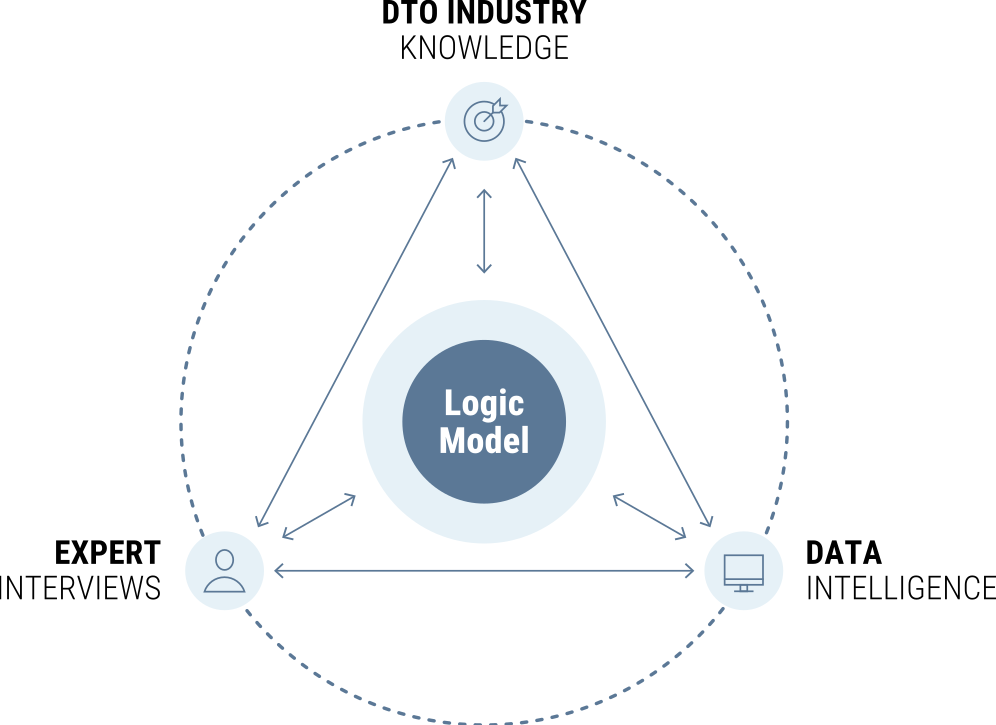
Systematically evaluate secondary sources such as databases, reports, information from industry associations, trade and customs statistics, and company information.
Expert interviews validate assumptions, close data gaps and explain the mechanisms behind figures and market movements.
Benchmarks, project experience and industry logic are combined with company-specific expertise to interpret evidence and derive sound decisions.
Publicly available statistics often provide an incomplete picture of specialised machinery markets. DTO therefore combines company data, production and trade statistics, installed-base models and project-specific secondary sources with interviews with manufacturers, dealers, users and industry experts. This creates robust market models rather than simply aggregated industry figures.
Market volume, unit volumes, installed base, prices and development scenarios.
Market positions, product portfolios, distribution structures and technological differentiation.
Applications, purchasing criteria, investment cycles and buying centres.
Prioritised countries, customer segments, applications and market development models.
We combine top-down and bottom-up approaches. These include production and trade data, company revenues, unit volumes, installed base, prices, dealer structures and assessments from market participants. Assumptions and ranges are presented transparently.
Yes. Depending on the market, we model the installed base using historical sales figures, life cycles, replacement rates, production data, imports and information from manufacturers, dealers and operators.
The installed base is segmented by factors such as age, technology, usage, level of automation and maintenance requirements. This allows us to identify potential for modernisation, spare parts, digital services and new business models.
Access to usage and operating data generated by connected machinery is becoming increasingly important. This may change aftermarket, platform and service models, among other things. DTO examines these developments in the context of competition, customer relationships and business models.
The EU Machinery Regulation will apply from 20 January 2027. For manufacturers, it may bring changes to conformity, documentation and digital or AI-based functions. DTO takes regulatory changes of this kind into account when assessing markets and competition.
Would you like to quantify market potential, assess new applications or prioritise international growth opportunities? Together, we define the market, the decision question and the appropriate scope of research.