
DTO · EN

DTO · EN
Did you manage to solve the recent matchstick puzzle? If not, here is an easier version that reveals an important principle of creative thinking: connect all nine dots using four straight lines without lifting your pen.
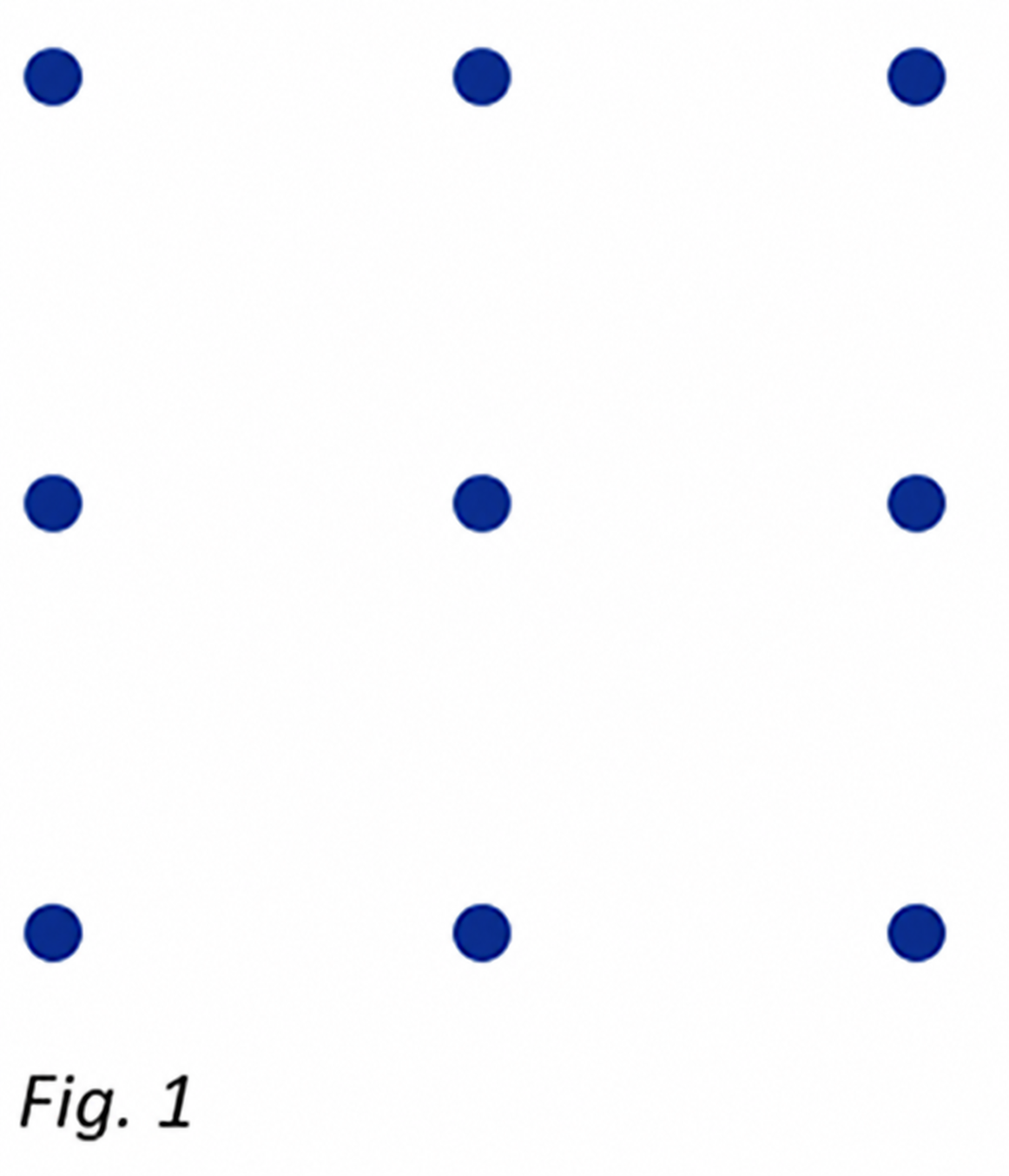
Your first attempt will probably look something like the second illustration. Discovering the solution shown in the third illustration often creates an “aha” moment. The difficulty with this problem, and with creative problems in general, is that prior knowledge leads us to assume boundaries that do not actually exist. Here, the outer dots appear to define a border beyond which we must not draw — a false assumption that makes the solution impossible.
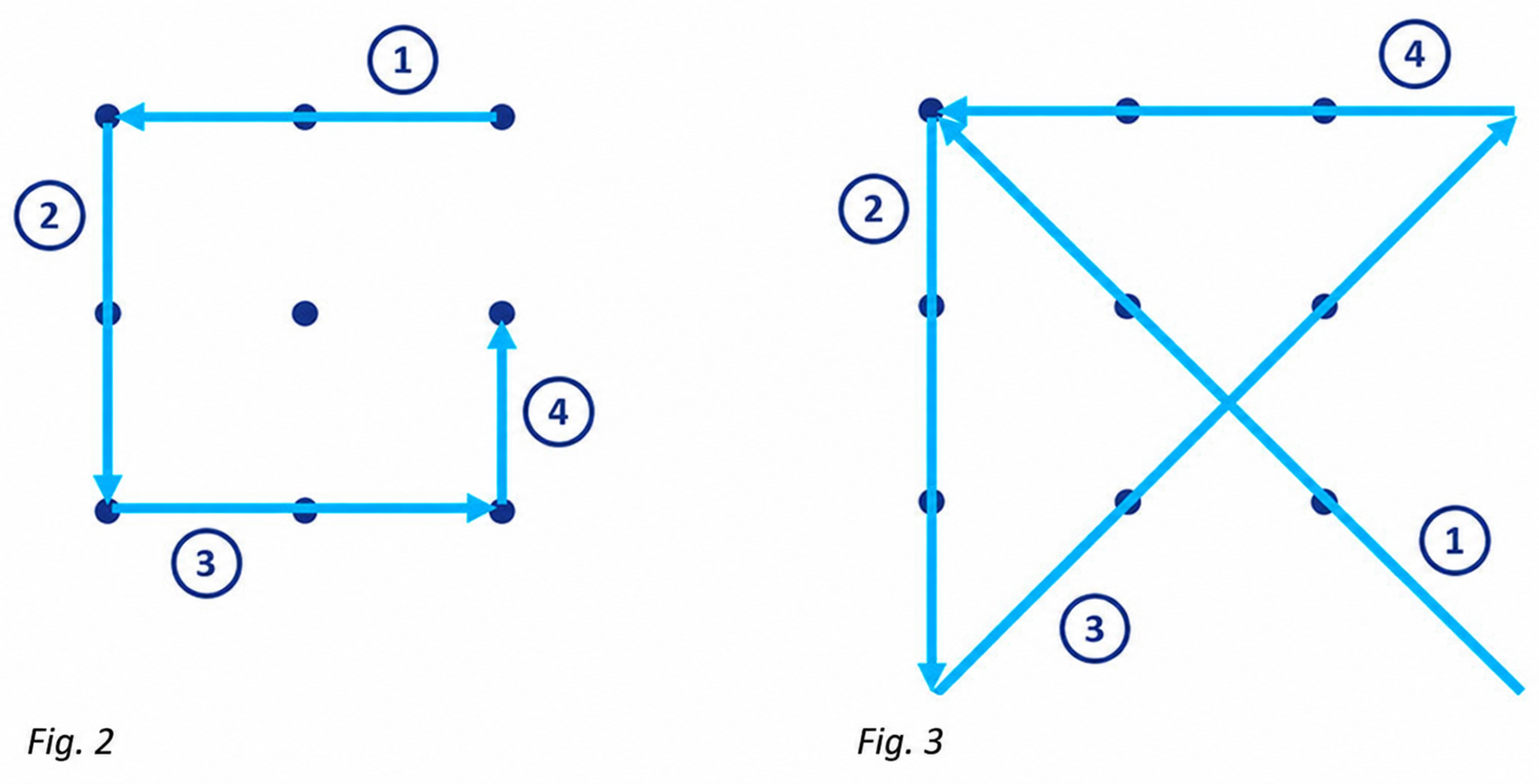
Back to the real world. The more you know about established solutions, the more aware you are of their respective limits. In other words, every problem-solving process begins with assumptions about the principles a possible solution will follow. Yet knowledge is indispensable to creative problem-solving. How else could you assess the novelty or quality of a solution? Cognitive processes fundamental to creativity, such as association and analogical thinking, rely on broad knowledge and the ability to recall and evaluate it quickly. So how can you break down the boundaries that arise spontaneously and involuntarily in your mind?
Become aware of your assumptions by abstracting the problem. Take the previous matchstick puzzle: subtracting numbers a and b, made up of the digits 1, 9 and 2, produces an incorrect result consisting of the digit 0. The assumption is that the solution must also be a subtraction using four digits. To find an alternative approach, remember that you are no longer sitting obediently in front of an immovable classroom blackboard. Turn yourself — or your device — upside down and change your perspective.
Back to reality once more. As much as we value playfulness, which can be an important motivational element in creative thinking, the current situation calls for greater seriousness. The two examples illustrate that anyone wanting to make full use of their expertise for creative ideas should first reflect systematically on their assumptions and then try changing their perspective on the problem. After all, Archimedes’ “Eureka!” came in the bath, not in the office…