DTO · EN

DTO · EN
When preparing bespoke market analyses in relatively opaque B2B markets, industrial market researchers repeatedly face new challenges. Each project requires its own research design. The approach resembles a puzzle: many small pieces of knowledge first have to be generated and then assembled to produce a realistic picture. Existing information is deliberately supplemented with new findings. This is an iterative process in which many different data sources are compared until a coherent relationship emerges.
To offer a small insight into this exciting and varied work, this article presents interesting facts about rotary encoders. Around two years ago, DTO conducted a ready-made market study on this subject. The analysis focused on industrial applications of rotary encoders; applications in consumer goods were deliberately excluded. The study illustrates our daily work in opaque markets and is also an excellent example of highly targeted segmentation and the classification of submarkets in market analysis.
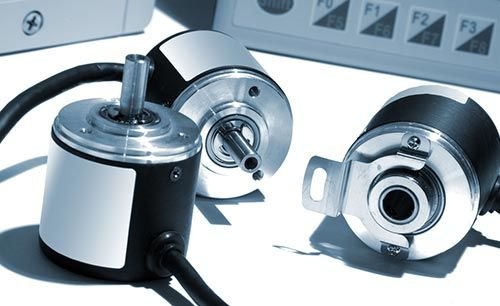
A rotary encoder is a sensor that detects the current position of a mechanical movement, measuring angular position and rotational speed, and converts it into an electrical signal. It sends this signal to an evaluation device. Rotary encoders are therefore used wherever the precise position of a movement needs to be known. Their main applications fall into two categories: drive technology and measurement technology. Drive technology accounts for the largest share of the market, at around 80%.
A distinction is made between incremental and absolute rotary encoders. Absolute encoders indicate the actual position directly. One major advantage is that the sensor retains its position in the event of a power failure. Absolute encoders can be used to detect both position and speed. Incremental encoders, by contrast, generate pulses step by step, so they measure only changes rather than communicating the actual position directly. Their simpler design also makes them less expensive. The range of applications appears almost limitless, from household appliances to excavators weighing many tonnes.
In Germany, the market for rotary encoders used in industrial applications was worth around €160 million in 2018. Market leaders include Heidenhain, Sick Stegmann, Baumer, Kübler, Pepperl & Fuchs and Hengstler. In total, however, more than 20 companies in Germany generate significant revenue from rotary encoders. Production facilities account for the largest share of end markets, at 30%. Absolute encoders using magnetic technology are commonly chosen in machinery and plant engineering. They make an important contribution to safe processes and provide the high accuracy required.
For both incremental and absolute encoders, material handling is the second most important industry. Encoders supplied for goods and materials handling systems account for around 20% of the market. Suppliers such as SICK AG even specialise in customised solutions exclusively for the logistics sector. In transport, which accounts for 19%, lifts are a very important segment. Around 15,000 to 20,000 lift units are built in Germany each year. Suppliers such as Kübler work with lift control system manufacturers to develop specially adapted rotary encoders.
In heavy engineering and safety applications, which account for 15%, SIL certification is common, classifying safety integrity levels from 1 to 3. Many manufacturers invest in certification for a SIL 3 rotary encoder, the highest SIL accreditation for these devices. Development and certification are expensive, however, and some customers are unwilling to pay the additional cost. Alternatives include using two encoders, preferably from two different manufacturers. Renewable energy is also one of the main industrial end markets, at around 9%; each wind turbine, for example, uses four to five rotary encoders.
Sales to OEMs play a very important role, as they account for the largest share of the sales market. The more technical and customisation features a customer requires, the more complex the sales process becomes. This process is usually accompanied by extensive consultation.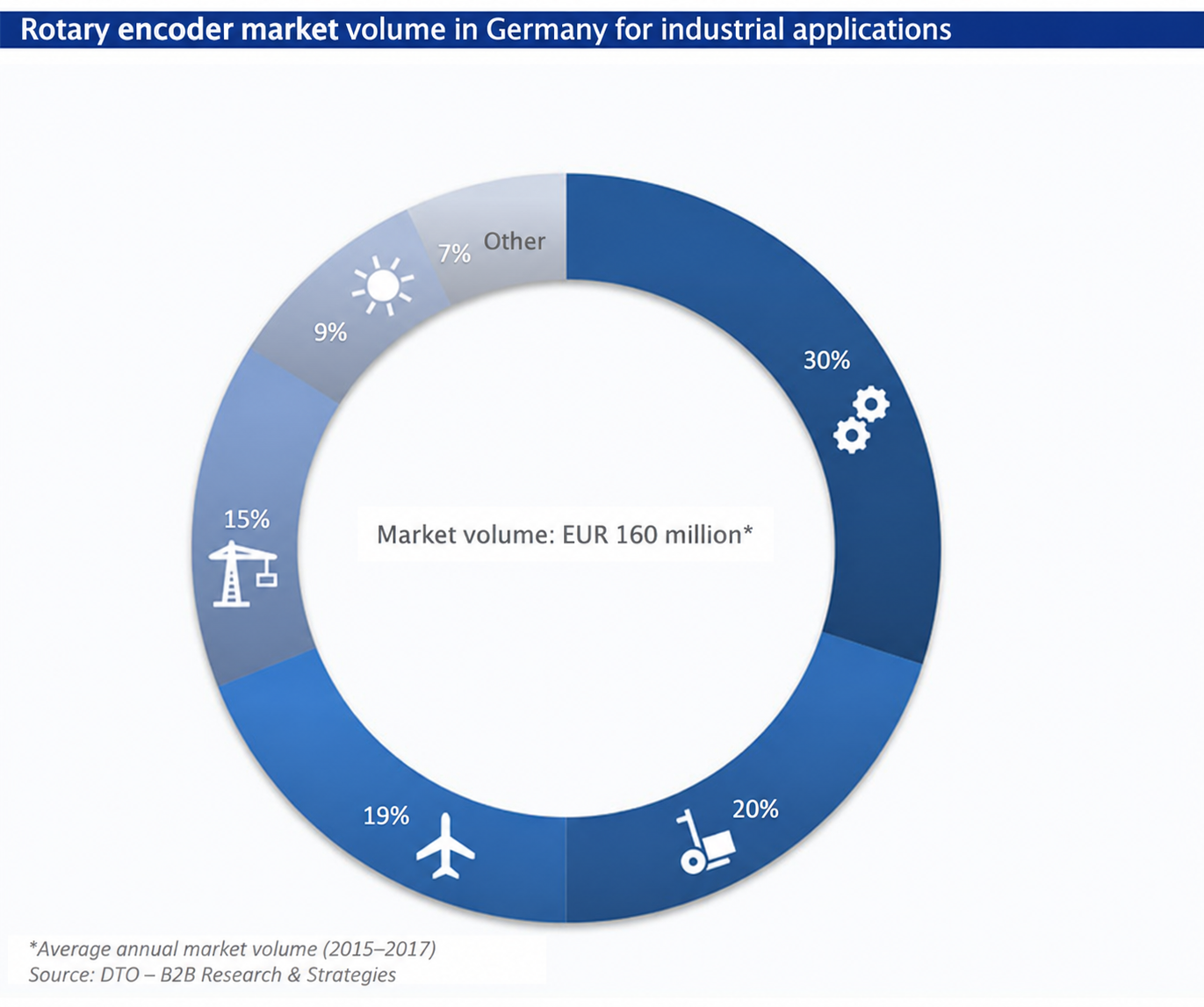 Market size for rotary encoders in German industrial applications: €160 million. Production facilities 30%; goods and materials handling 20%; transport 19%; heavy engineering and safety applications 15%; renewable energy 9%; other applications 7%. *Average annual market size, 2015–2017. Source: DTO – B2B Research & Strategies.
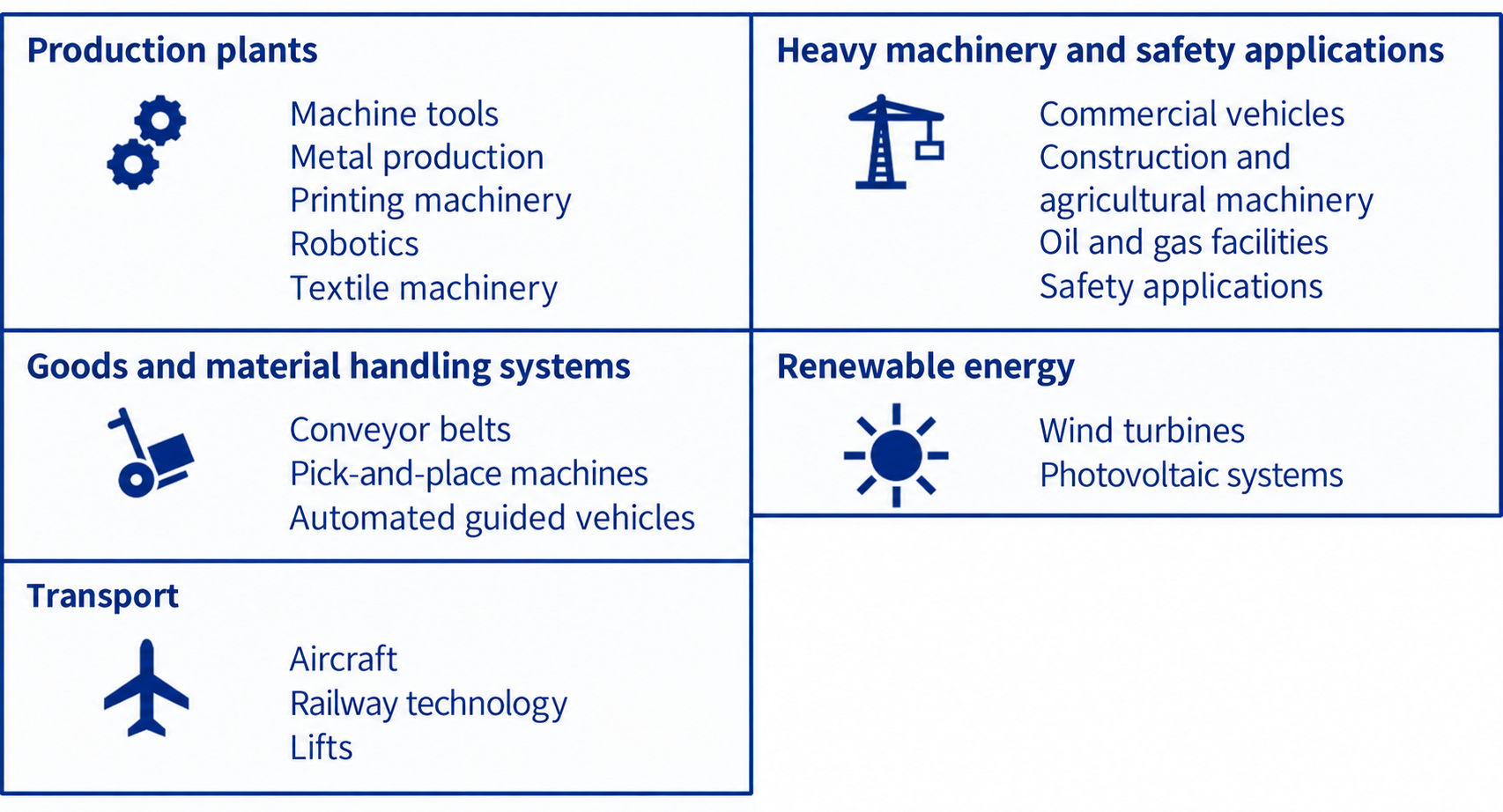 Applications by sector. Production facilities: machine tools, metal production, printing machines, robotics, textile machinery. Goods and materials handling: conveyor belts, pick-and-place machines, automated guided vehicles. Transport: aircraft, railway technology, lifts. Heavy engineering and safety: commercial vehicles, construction and agricultural machinery, oil and gas facilities, safety applications. Renewable energy: wind turbines and photovoltaic systems.
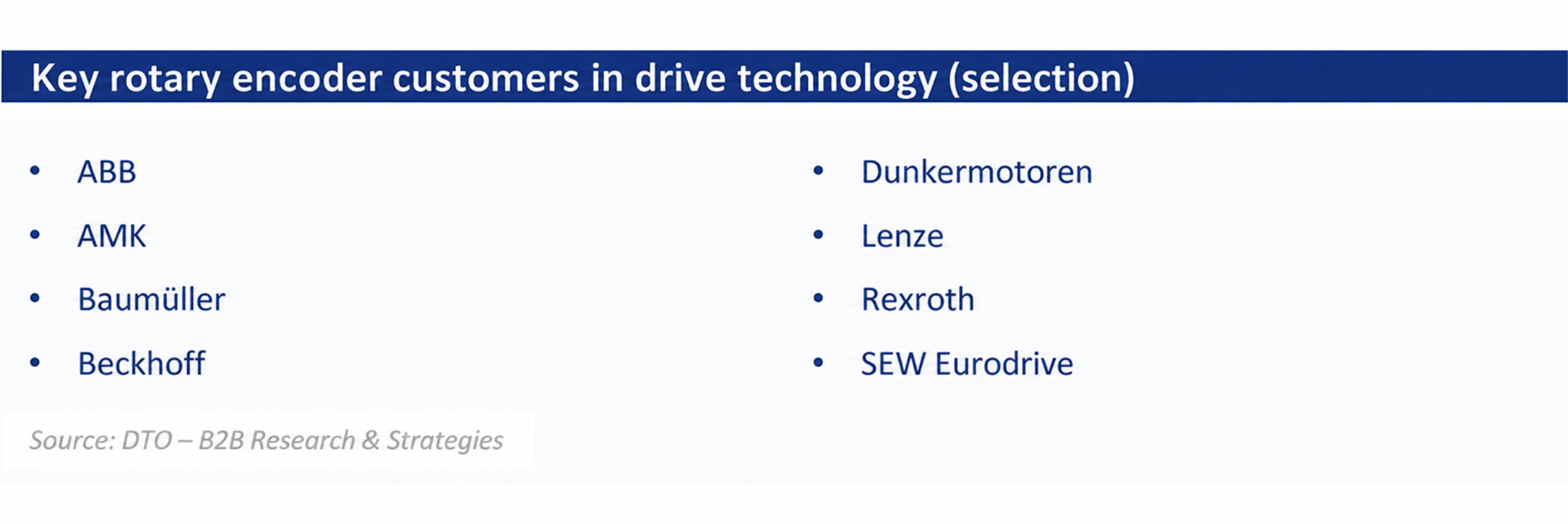 Selected major buyers of rotary encoders in drive technology: ABB, AMK, Baumüller, Beckhoff, Dunkermotoren, Lenze, Rexroth and SEW Eurodrive. Source: DTO – B2B Research & Strategies.
High-resolution incremental encoders are frequently used in drive technology because their performance is only marginally affected by external conditions. They withstand high operating temperatures, substantial vibration and shock loads, and high speeds. Although measurement technology represents a smaller end market than drive technology, increasing automation is expected to drive growth in this segment. As automated processes and systems continue to expand, particularly in German manufacturing, greater use of measurement technology will become essential.
Because absolute encoders can determine precise positions, they are frequently used in measurement applications. Growth in the measurement technology market is therefore also expected to support growth in absolute encoders.
Please contact us if you would like further information on this subject. We will also be happy to help with any other questions about industrial market research and strategic consulting.