DTO · EN

DTO · EN
In today's rapidly evolving business landscape, innovation is no longer a luxury but a necessity for companies to stay competitive, especially in the B2B sector. With increasing pressure to meet changing customer expectations and outpace competitors, businesses must continuously adapt their strategies and offerings. Innovation, whether through new products, services, or business models—drives growth and differentiation in crowded markets. However, identifying the right opportunities for innovation requires more than just intuition or guesswork. This is where market research plays a crucial role. By providing deep insight into customer needs, market gaps, and emerging trends, market research helps companies make informed decisions and uncover untapped opportunities. Relying on market research rather than assumptions or outdated methods ensures that innovation is grounded in data, leading to more effective and sustainable business strategies. In this article, we’ll explore how market research can be a powerful tool in discovering innovative opportunities that drive business success.
In the B2B space, innovation goes beyond incremental improvements; it encompasses the development of new products, services, processes, or even business models that transform how companies operate or deliver value. Unlike simple upgrades, innovation addresses significant market needs or disruptions, often creating a competitive advantage. Market research is essential in identifying these innovation opportunities by providing data-driven insights into key areas that drive change.
By combining customer insights, competitive intelligence, and trend analysis, market research acts as a catalyst for innovation, guiding B2B companies to create solutions that resonate with the market and lead to long-term success.
To effectively identify innovation opportunities, it’s essential to leverage various types of market research. The specific research methods chosen will depend on the company’s objectives, as different approaches provide unique insights that align with different strategic goals. For example, if the focus is on understanding customer pain points, qualitative research such as customer interviews or focus groups may be the best option. On the other hand, if the goal is to quantify market demand or validate a hypothesis, quantitative research using surveys and big data analytics would be more appropriate. Competitive intelligence is crucial for companies aiming to differentiate themselves in a competitive market, while trend analysis can help those seeking to stay ahead of market shifts and emerging technologies. The table below outlines each research method and how it supports specific business objectives, ensuring that the market research approach is tailored to uncover opportunities that align with the company’s innovation strategy.
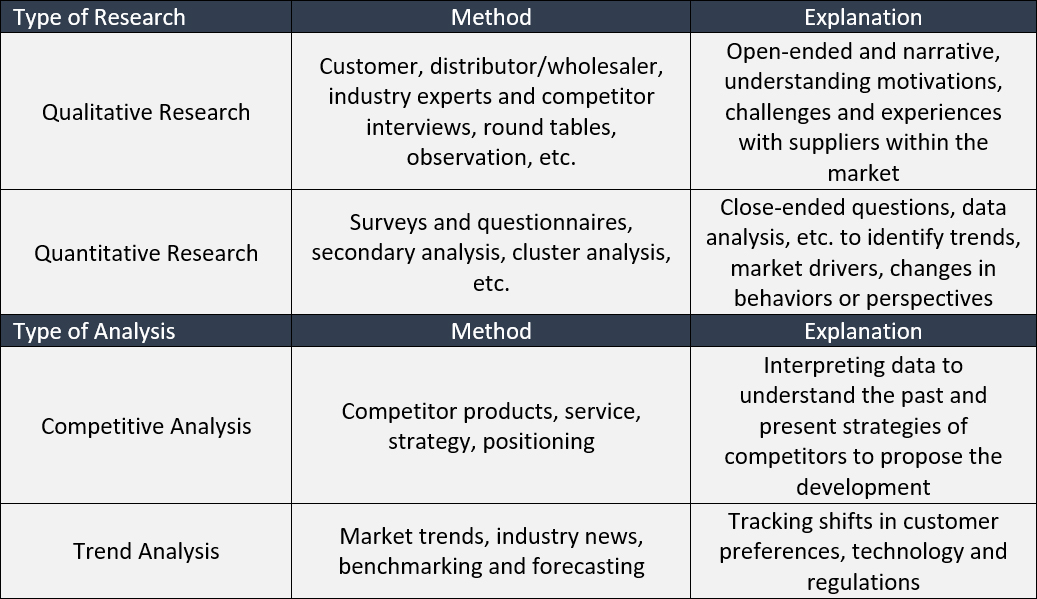
Some projects may require a combination of these research types to provide a comprehensive view of the market and ensure that all angles are explored.
Market research plays a crucial role in spotting market gaps, revealing areas where customer needs are not being fully met or where competitors are failing to deliver. By identifying these gaps, businesses can seize opportunities to introduce innovative solutions that better serve their target market.
Leveraging market research insights to drive innovation while addressing common challenges requires a strategic and data-driven approach. As a project manager at a B2B market research firm, I’ve seen firsthand how transforming ideas into actionable insights is the key to success. Innovative concepts born from initial research must be validated through additional testing to ensure they resonate with the target audience and meet real market demands. This rigorous process helps avoid common innovation pitfalls, such as investing in ideas that lack sufficient demand or fail to address customer needs effectively.
By integrating data-driven insights with organizational goals, companies can overcome these challenges and unlock innovation that drives sustainable growth and competitive advantage.
In today’s fast-paced business environment, partnering with DTO ensures that your organization has the insights needed to identify and validate innovation opportunities with confidence. A strong market research partner like DTO plays a pivotal role in uncovering actionable intelligence that drives strategic growth. By investing in robust market research, your business can outpace competitors, align with customer demands, and build a foundation for sustainable innovation. As markets and customer expectations continue to evolve, ongoing market research is not just a tool but a necessity for staying ahead of the curve and seizing future opportunities. Choose DTO as your trusted partner to navigate change and lead your industry into the future.
Text written by Sydney Schüler